
The CY-109 Android tablet scam
Note: This is a translation of an article I had written back in late 2019. I've recently discovered that the company selling this tablet in Italy went bankrupt a long time ago, some time after threatening me with legal action if I didn't delete the original article (which I didn't, of course). I've now decided to translate it, mainly so people are more aware of such scams.
Introduction
I needed a (very) inexpensive tablet to use with OpenCPN (a software for nautical charts) and SDR Touch (a software for Software Defined Radio on Android). That way, if it were to get wet or end up straight in the sea, I could replace it without too much hassle.
While browsing eBay, I came across many tablets with rather uninspiring specifications (512 MB of RAM or worse), which were naturally ignored.
One of them, however, looked promising enough at least for my uses. The specs listed Android 7, an octa-core CPU, 4 GB of RAM, and 64 GB of eMMC storage (referred to as "ROM" by the seller).
Ultimately, though, the product turned out to be much more than just disappointing. Let’s take a look at why!
Official Specifications
- 10.1" 1280x800 display
- Octa-core CPU
- Mali400 MP2 GPU
- Android 7 or higher (whatever that means?)
- 4GB DDR3 RAM
- 64GB ROM (approx. 58GB usable)
This model, the CY109G, is available not only on eBay (both in Italy and abroad) but also through other sellers like AliExpress and Taobao, in various versions. However, the other sellers don't advertise its specs in the same way: many listings are for just 2 GB of RAM and 8 GB of eMMC storage.
Android version
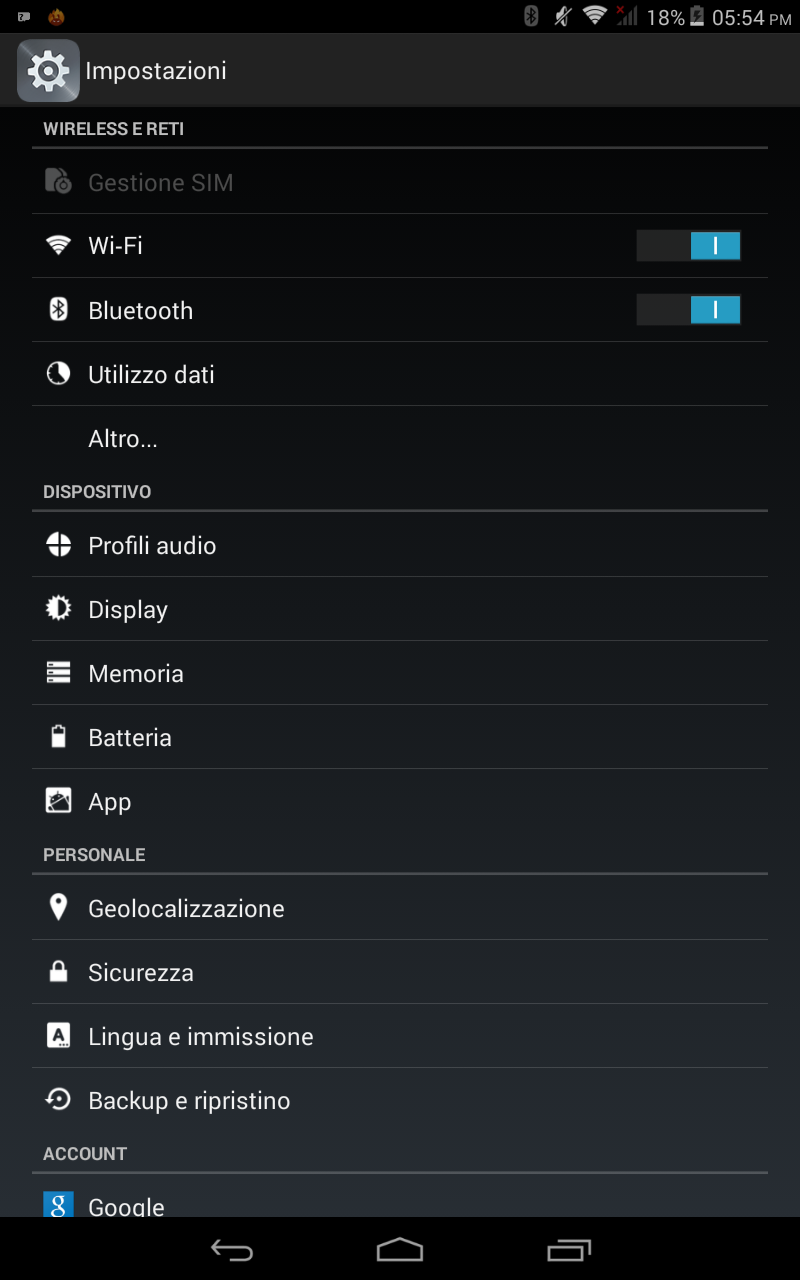
My first doubts regarding the device's authenticity arose when I opened the Android settings. Anyone who has used Android for a long time will know that, prior to Android 5 (Lollipop), Google did not yet use the "Material Design" that is so familiar to us today; instead, it used a different design language (I believe it was called "Butter"). It is recognizable by its cyan switches and checkboxes, a dark gray background, and very bright white text.
Here is what the screen looks like on this tablet, which is supposedly running Android 7, yet looks nothing like it.
However, upon navigating to "About tablet," it claims (alongside a bunch of nonsense, such as inch 2560*1600 retial sceen) that the device is running Android 7.0. How is that possible?!
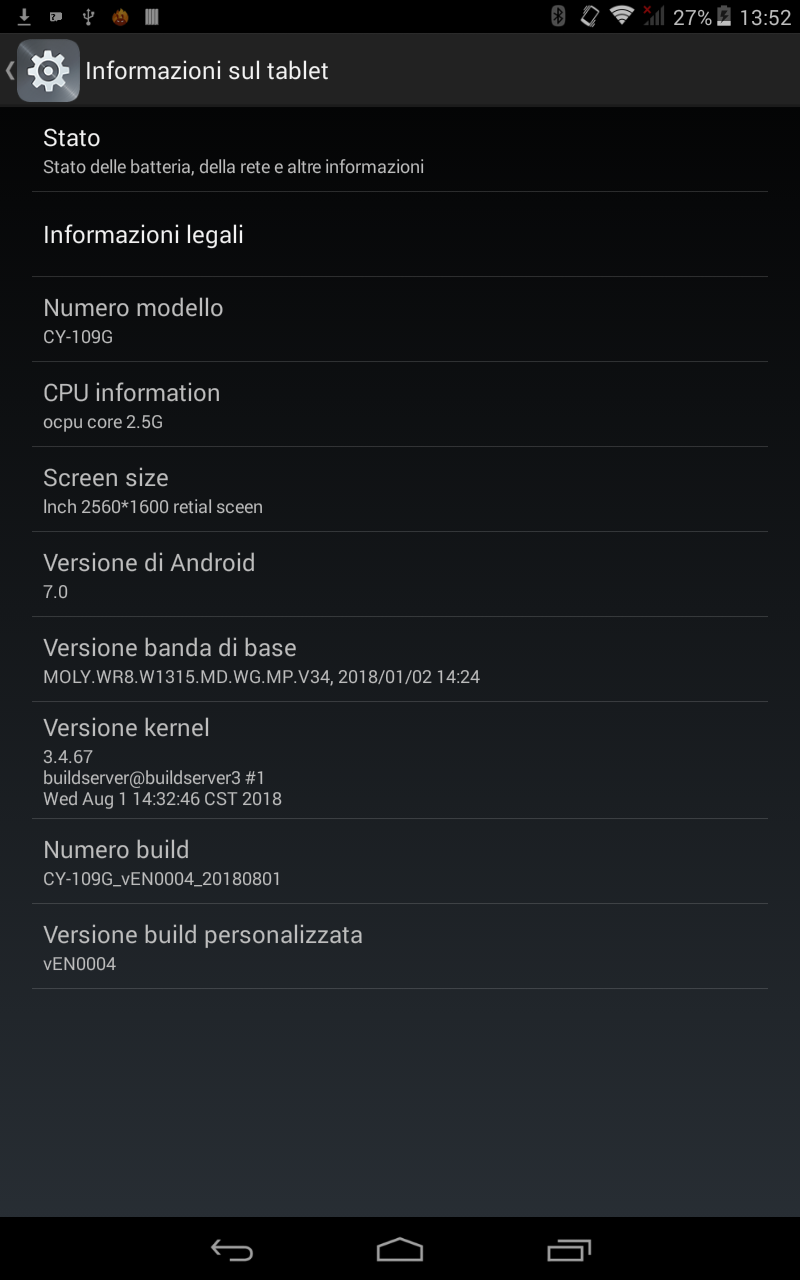
Tapping the "Android version" entry five times should reveal the logo for that specific version of Android through the easter egg included for each release. On this tablet, however, it displays the logo for... Android 4 KitKat! It would just so happen that KitKat is the last version that did not use Material Design! A coincidence?!

How do you fake the Android version?
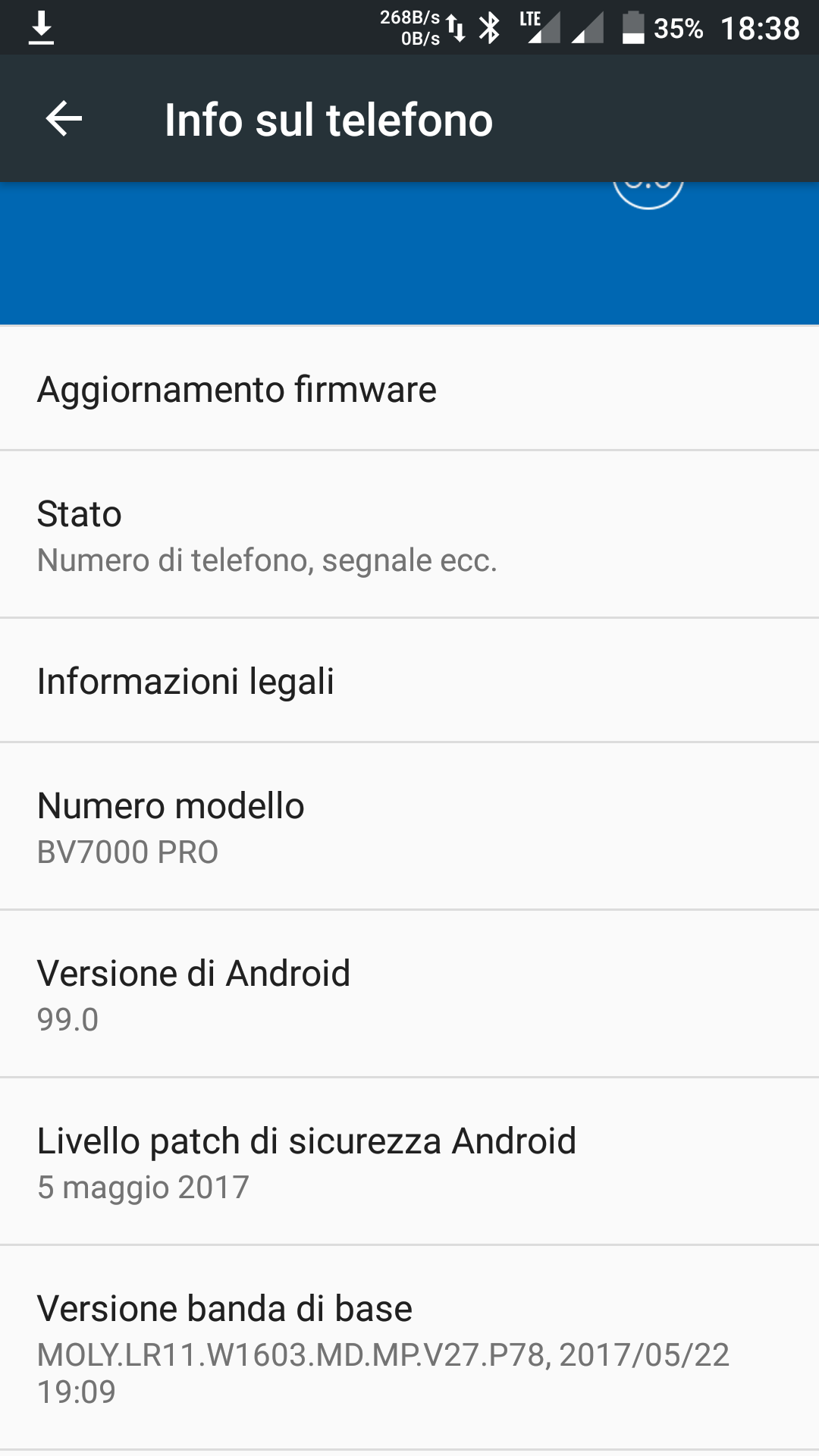
It couldn't be any simpler: you modify the build.prop file, locate the ro.build.version.release parameter, and set it to whatever version you like.
For instance, here I set it to 99.0 on my Blackview BV7000 phone (which runs Android 6). Look at that!
eMMC storage (ROM)
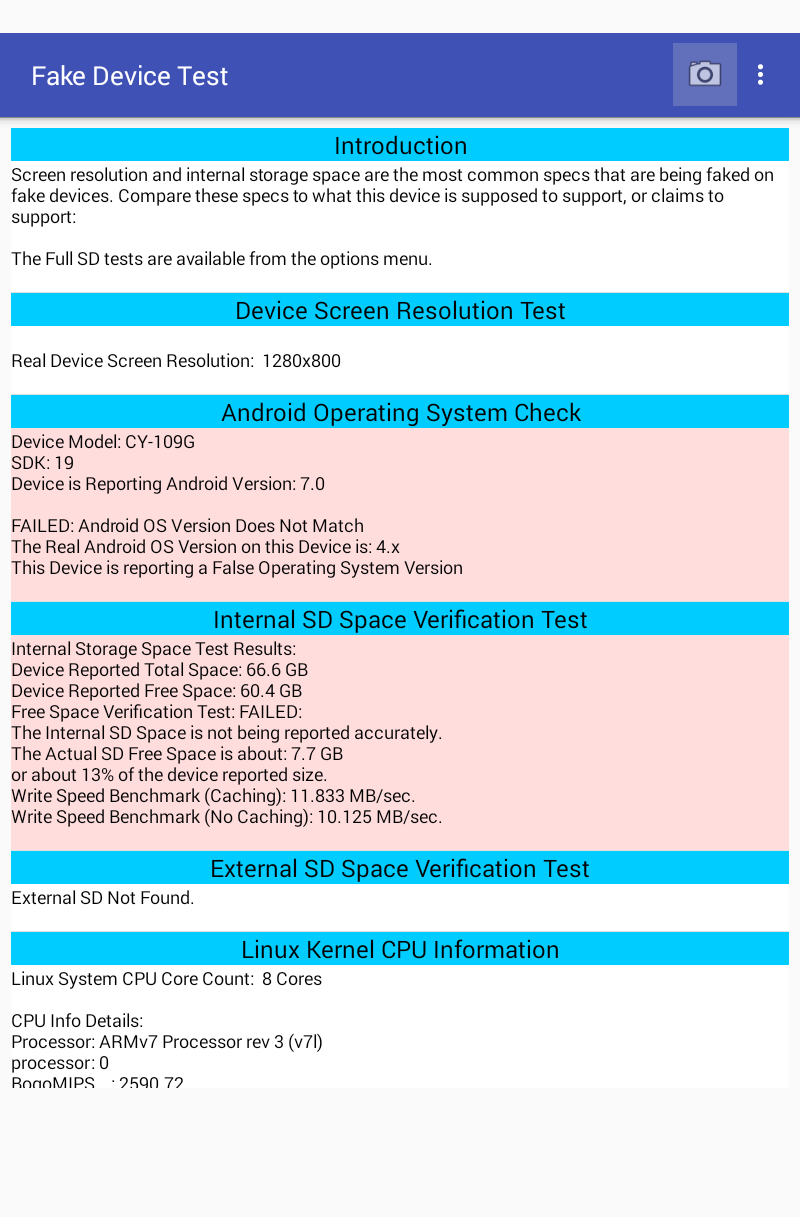
Naturally, the deception doesn't end with the Android version but far from it. The eMMC storage has also been tampered with; it isn't actually 64GB, but rather a measly 8GB. The method used is the same as that employed for counterfeit microSD cards and USB flash drives: the controller tells the operating system that the capacity is X, when in reality it is Y. Once you write more data than can be held in Y, the older data is simply overwritten (corrupting everything in the process).
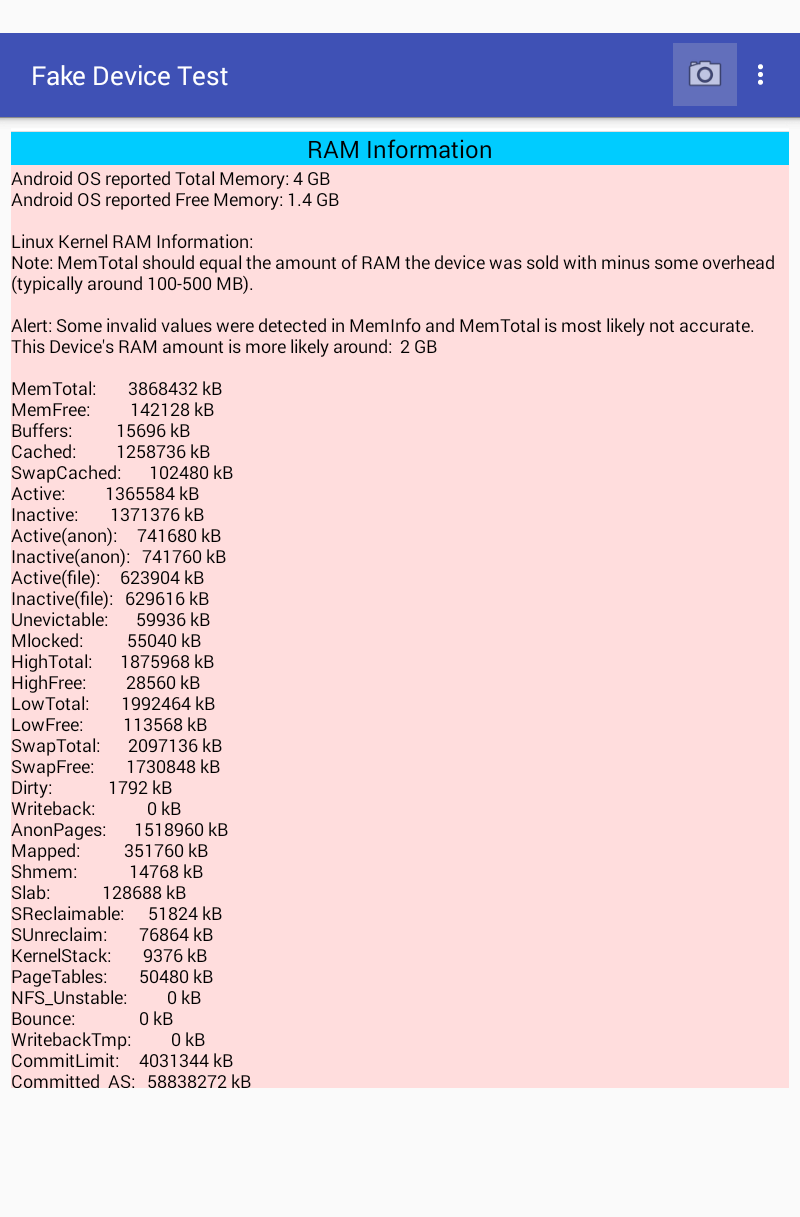
You can use the "Fake Device Test" app (available for free on the Play Store) to easily determine the true size of the eMMC:
RAM
The same trick was applied to the RAM. In this case, however, the Linux kernel has been modified to prevent the system from using more than X GB, where X is the actual amount of physical memory. If that weren't the case, the tablet would crash once a certain amount of memory was used, much like what happens with counterfeit graphics cards.
You can spot this practice easily because Linux typically uses almost all available (unused) RAM as a cache, whereas this tablet was only using slightly less than half of its reported capacity. It means that the true capacity is 2GB, not 4GB as in the specs.
Once again, "Fake Device Test" does an excellent job:
CPU
Naturally, the deception wouldn't be complete without some tampering with the CPU as well. CPU-Z detects a Mediatek MT6592T, which, according to official specifications, should feature 8 cores running at 2.0 GHz.
However, as you can see, even under maximum load, not all cores are active, and the maximum speed is only 1.3 GHz.
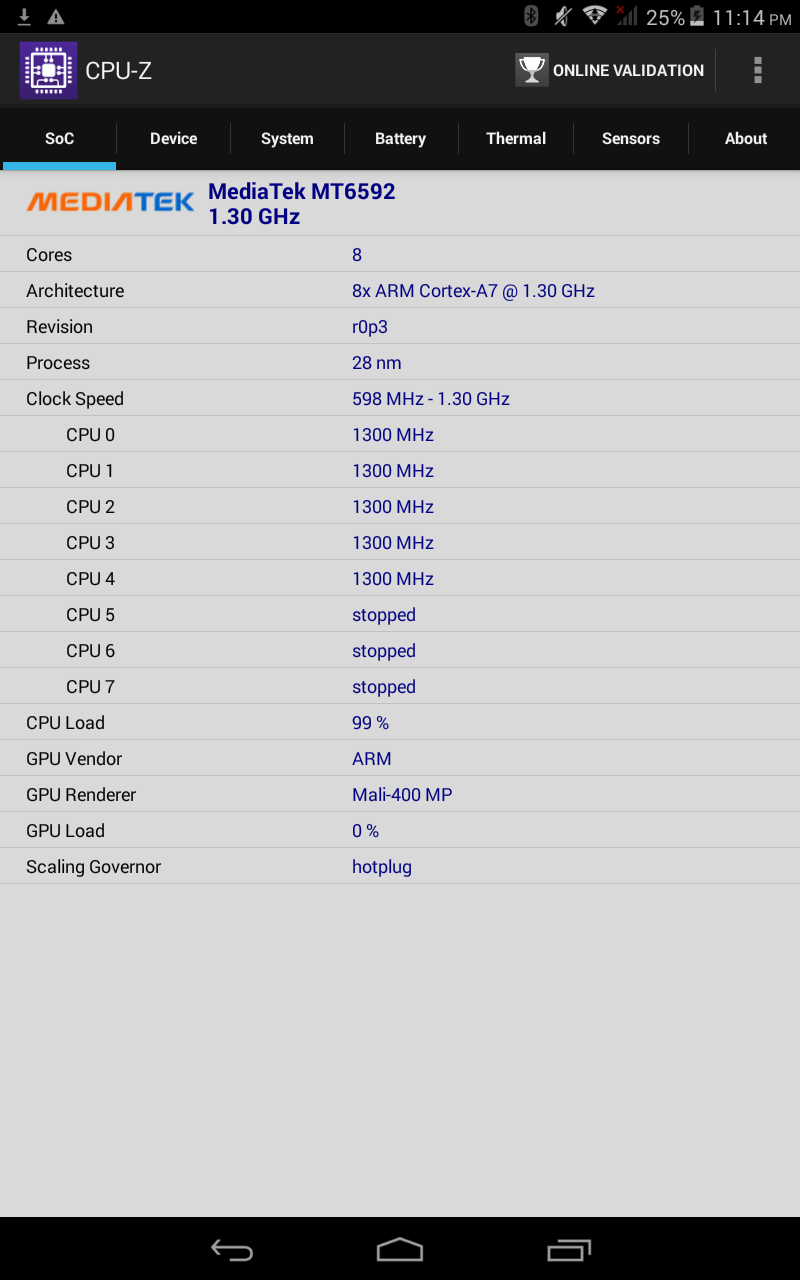
I have no way to verify this for certain, but I suspect it is simply a faulty CPU that failed quality testing. Three defective cores were disabled, and the clock speed was throttled down.
GPU
The GPU is supposedly a Mali-400 MP, but as soon as you open any game that utilizes OpenGL ES, the tablet displays a pink screen and crashes.
I cannot confirm the exact reason, but I suspect that the GPU has also been tampered with, the other modifications to the software somehow corrupted the renderer, or the hardware is simply defective.
Power adapter
Unfortunately, many devices coming from China just wouldn't be complete without a power adapter that features highly questionable electrical safety and, quite possibly, specifications that are significantly overstated!
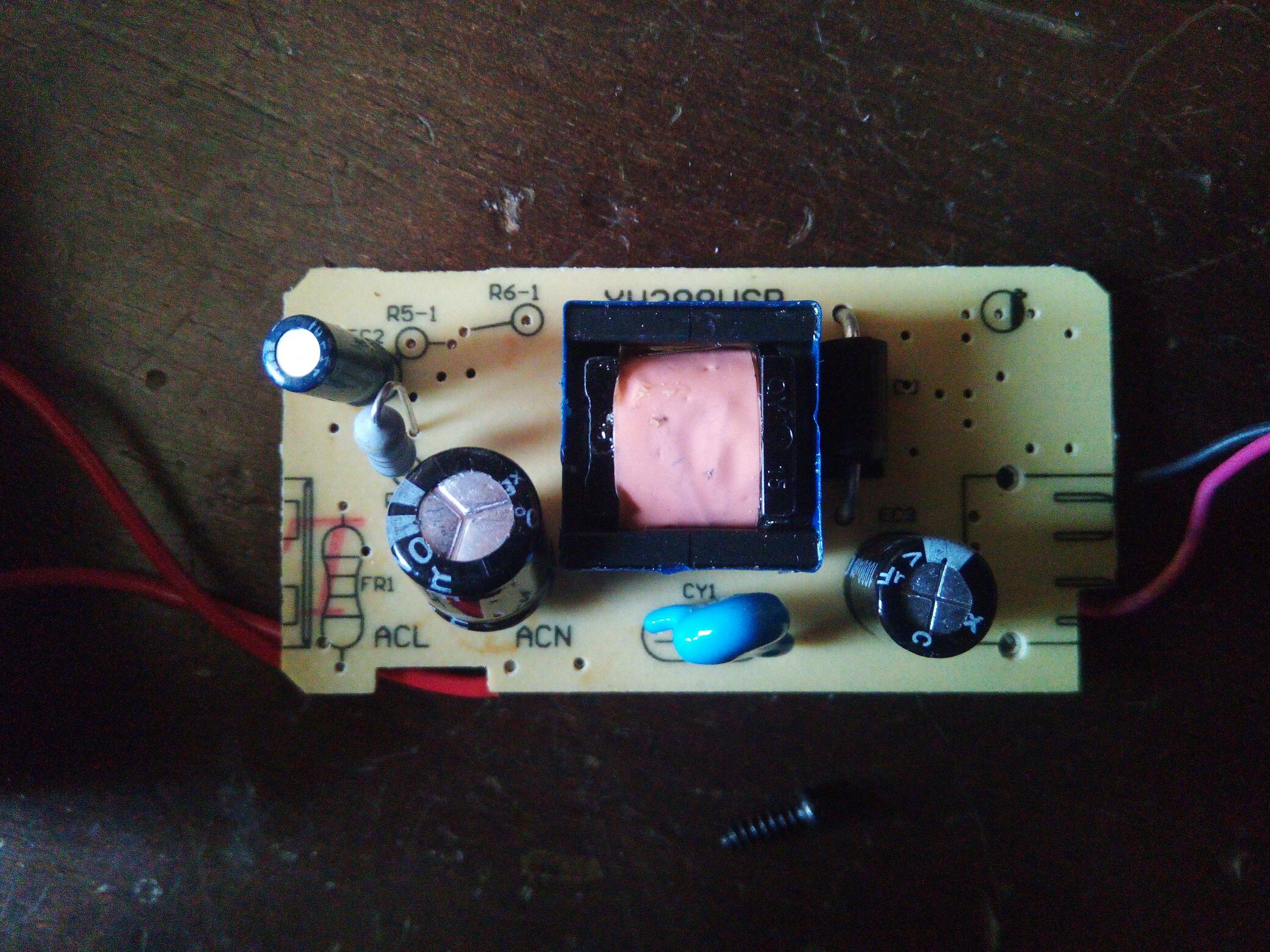
Officially, the power supply is rated at 2 A. The casing already smells of burnt plastic...
Inside, we find the typical cheaply-made circuit with every optional component removed. It lacks an interference filter and a fuse (marked "F1" on the PCB, but replaced by a makeshift "fuse" trace); the coupling capacitor (CY) is not a safety-rated type (it is blue, but bears no safety markings); and the minimum required clearance (at least 5 mm) between the primary and secondary sides is not maintained.
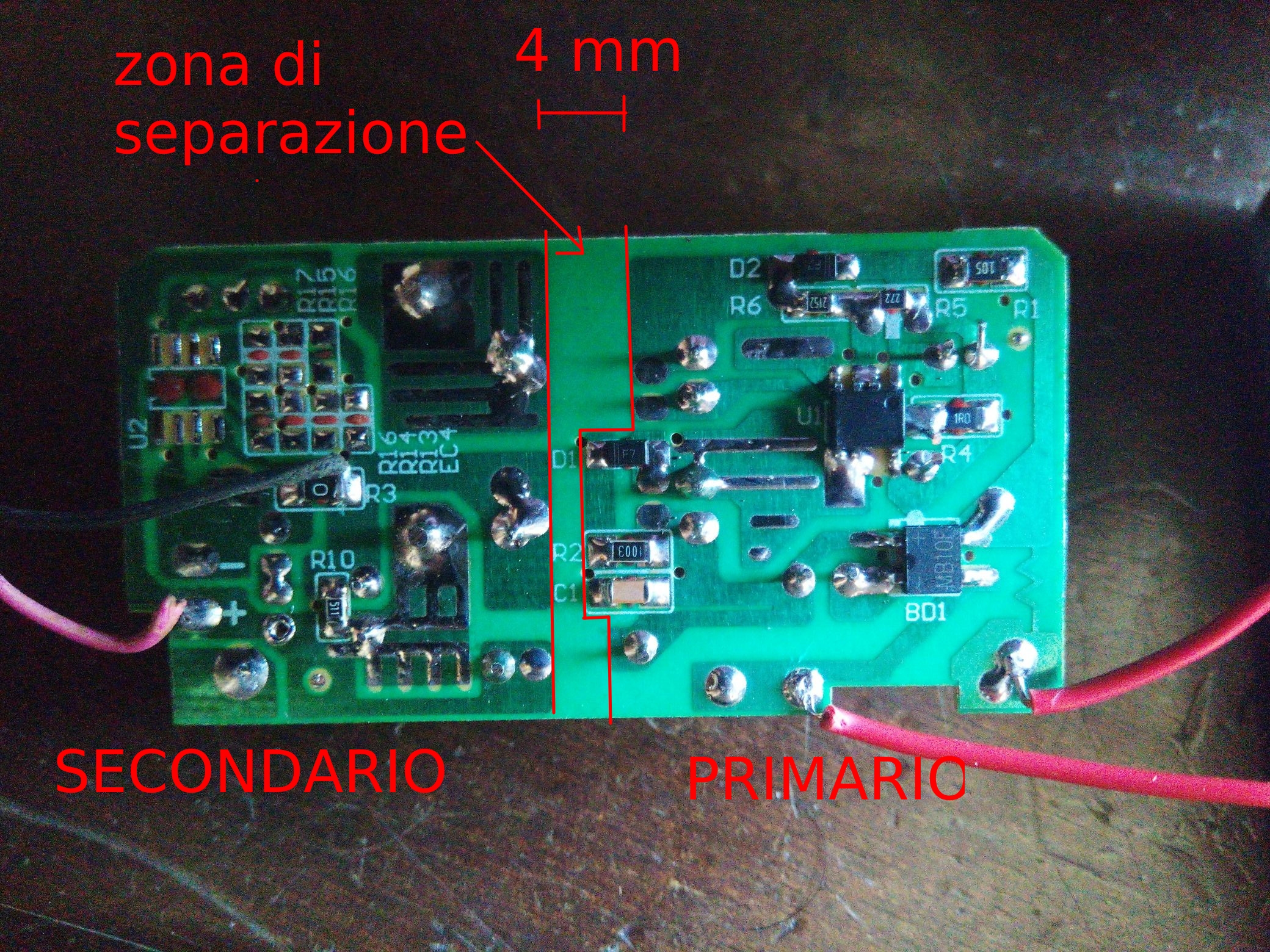
The electrical performance is exactly like you'd expect from such a construction: at just 0.3 A, the voltage already drops to 4.6 V, which is below USB specifications. At 1 A, the voltage plummets to 3.65 V.
The charger failed the 1 kV Hi-Pot (high potential) test, making it unsafe for use even with a 115 V mains supply. Touching the tablet while it is charging results in a mild electric shock, almost certainly caused by a leaky CY capacitor.
I did not disassemble the transformer to check the insulation of the windings, as there would be no point. You already get shocked as it is.
Final verdict
Personally, given the points mentioned above, I do not recommend purchasing these tablets.
A thorough search across various e-commerce sites reveals several versions: some with 2 GB of RAM, others with 4 GB (the same applies to the eMMC storage), all sharing the same model code: CY-109. I haven’t purchased any other tablets to verify, but I get the impression that the version with 2GB of RAM is the "unmodified" one, while versions with more RAM are the "modified" ones.
If you happen to get your hands on the "unmodified" version, the tablet itself isn't actually bad for the money, though the power adapter should be replaced with a higher-quality one.
The shameful behavior of the seller
As soon as I published this article and left a negative feedback on eBay regarding this blatant scam, the seller played the "fake cease-and-desist" card to protect their own interests. Clearly, it didn't do much good, as less than two years later, the company "Easy Solution International SAGL" ended up in liquidation. I wonder why...
Given the shameful behavior of EasySolution (and those who run it), I feel it is entirely appropriate to share the full text of the "cease-and-desist" toilet pap... pardon me, the highly valid legal notice that I received.
Setting aside the usual whining about VAT, crushing tax burdens, exorbitant costs, and so on (did they know that no one forced them to become importers if they didn't want to?), there are a few issues with the formal notice in question:
- There is no law - neither Italian nor European - that mandates that only a technical expert (perito in Italian) can certify a discrepancy. Actually, under Italian law, purchasing counterfeit goods is a criminal offense; therefore, the burden of verification lies with the customer. That is, the exact opposite of what good old Peran claims.
- I highly doubt that INTERPOL (which is written in all caps, as it is an acronym) would have any interest in this matter.
- In any case, one does not file querela with INTERPOL; rather, one files it within one’s own national judicial system, which may then, if necessary, reach out to INTERPOL.
- The statement, "Finally, when 2017 is mentioned, it refers to the development of the patent-model design, not the actual product received, which is clearly an updated version of that same model, manufactured more recently," is so absurd it borders on the grotesque (and is, naturally, a complete fabrication, given that the tablet runs an OS released in 2014).
- The phrase "If you feel cheated" is the icing on the cake, the most basic and obvious attempt to silence someone when the other party knows full well they are completely in the wrong. Oh, I feel cheated today! I have this overwhelming, burning desire to waste hours of my life testing whether this piece-of-junk tablet actually meets the specifications for which I purchased it.
- How would our friend Peran have reacted if I’d been electrocuted by the power adapter? Would one need to be a qualified electrical or electronics engineer to get shocked by the faulty power supply? Who knows...
- It’s amusing to see the adjective "genuino" (which means "genuine" in Italian, but referring to the quality of food) applied to consumer electronics. What’s next, "organic" or "protected designation of origin" (DOP) electronics?
- If they truly respected customer rights, they wouldn't resort to playing these kinds of games. Instead, they would do what many other companies in similar situations have done: provide a refund without any hassle, and even thank me for the suggestions I offered...
The subsequent response defies all logic even further:
Once again, there are a few minor issues:
- The crime of defamation under Italian law (but surely also other countries...) does not work the way our friend Peran claims.
- Email is not the appropriate medium for sending a formal legal notice (cease-and-desist or similar), as it carries no legal weight.
- If I haven’t received an item and have clearly been scammed, I am fully within my rights to write about it on the Internet, citing the company’s name and any other relevant details. Should the company attempt to sue me for defamation, the case would immediately collapse: many have tried before, and they have lost every single time, as one would expect in a functioning state governed by the rule of law.
- "Once the Carabinieri arrive knocking at your door" is another delightful bit. Why not throw in a helicopter and the Marines while they’re at it? The Air Force and the Navy too, come on!
The rest of the emails follow much the same pattern: Mr. Peran keeps demanding that I delete the page entirely, and I keep refusing, pointing out that since his company’s name isn’t even mentioned, he has no authority to order me to do anything. I also suggested that he was more than welcome to take one of his pieces of junk, pardon me, his "magnificent" tablets, complete with patented design, install "Fake Device Tester", and see for himself. After five or six ridiculous exchanges, the final gem arrived sent from the same email address, though this time the sender was supposedly the lawyer representing this "mega-corporation". Due to the subtleties in the Italian language, I'll also copy the original one:
What can I say? Seeing the overly formal term "codesta" (this/that) paired with the very much casual "tutto ok" (everything is ok) in the same sentence certainly wasn’t on my bingo card for the day.